Menu

News

Menu

News

Menu

News

Rena Torres Cacoullos

Rena Torres Cacoullos
Liberal Arts Professor of Spanish and Linguistics
Interim Head

Curriculum Vitae

Biography

Rena Torres Cacoullos is Professor of Spanish and Linguistics. She looks for quantitative patterns in everyday language use. Her classes are on grammatical variation across the Spanish-speaking world, cognitive and social factors in language change, and grammar from a usage-based perspective.

Co-author of Bilingualism in the Community: Code-switching and Grammars in Contact, most recently she has tried to understand language variability and changeability across bilingual speakers. Applying the tools of linguistic variation theory pioneered by William Labov to bilingual speech communities, her studies show that bilinguals who regularly use both their languages are adept at keeping them connected, yet separate. On the one hand, the languages are “separate”, since bilinguals’ two grammars remain intact, aligning with their respective monolingual benchmarks rather than with each other. Language-particular grammatical patterns hold for subject pronoun expression, tense-aspect-mood, and word order, among other linguistic variables in Spanish-English bilingual speech. Additional evidence comes from cross-language structural priming: it exists, but is weaker than within-language priming. On the other hand, the languages are “connected”, since bilinguals combine them, in two principal ways: borrowing (single-word incorporations) and code-switching (alternating-language multiword strings). While often socially stigmatized or perceived as jumbled, code-switching requires learning at which junctions between the two languages it occurs. Current research projects reveal that bilinguals strongly prefer code-switching at prosodic boundaries—the Intonation Unit Boundary constraint—and with equivalent syntactic variants that are more frequent and predictable—the Variable Equivalence hypothesis.

Recent Publications:

  • Rebecca Pattichis, Dora LaCasse, Rena Torres Cacoullos. 2025. Re-evaluating the word token for bilingual speech processing: The case for Intonation Units. Computational Linguistics; doi: https://doi.org/10.1162/COLI.a.580
  • Bybee, J. & Torres Cacoullos, R. 2025. Joint Innovation: An alternative to the initiation-diffusion and speaker-listener dichotomies in language change. Journal of Historical Linguistics. https://doi.org/10.1075/jhl.24028.byb
  • Torres Cacoullos, R. & LaCasse, D. 2024. Bilingual clause combining: A Variable Equivalence hypothesis for conjunction choice. International Journal of Bilingualism. https://doi.org/10.1177/13670069241265587
  • Travis, C. E. & Torres Cacoullos, R. 2023. Form and function covariation: Obligation modals in Australian English. Language Variation and Change 3: 351-377. https://doi.org/10.1017/S0954394523000200

Education

Ph.D., Hispanic Linguistics, University of New Mexico

Research Interests

Language variation and change, corpus linguistics, bilingualism

Courses Regularly Taught

3 Credits

Graduate Linguistics

SPAN 597 Code-switching
This seminar will provide an examination of codeswitching (CS), drawing on corpus- and lab-based methods. We will attend to bilinguals' linguistic experience and community norms as impacting the cognitive representation of language and thus linguistic structure. We will address (1) linguistic concerns with constraints on CS by asking: Is CS favored at particular syntactic and prosodic junctures of the two languages? and (2) psycholinguistic concerns with the facilitation of CS by asking: Is CS predicted by "triggering" (either situational, e.g., by the interlocutor, or linguistic, e.g. by cognates)? Rather than assume that bilingual patterns need be derivable from syntactic principles for monolingual grammar, our goal will be to identify bilingual CS strategies—quantitative preferences to switch at particular sites and structural adjustments for switching at dispreferred sites. Students will present and evaluate published articles; learn to extract and code data from spontaneously produced CS; and conduct a pilot study toward an original research proposal.

Current Graduate Advisees

Kevin McGovern Profile
Co-President, SIPGSO

Publications

Sintaxis del español / The Routledge Handbook of Spanish Syntax

Sintaxis del español / The Routledge Handbook of Spanish Syntax

Editor(s):

Publication Date:

About the Book

El volumen Sintaxis del español/The Routledge Handbook of Spanish Syntax proporciona una visión general de los temas fundamentales de la sintaxis del español, basada en datos extraídos de corpus textuales, sensible a los fenómenos de variación y conectada con otros componentes de la lengua. La obra, escrita en español, reúne perspectivas teóricas diversas, elaboradas por un grupo internacional de lingüistas. Está dividida en seis partes y comprende 45 capítulos centrados en cuestiones teóricas, cláusulas, oraciones y estructuras supraoracionales, categorías verbales, frases y clases de palabras, variación y cambio sintácticos, así como acercamientos computacionales y sus diferentes aplicaciones. El volumen constituye una referencia fundamental para los investigadores al tiempo que proporciona una introducción accesible para estudiantes de la lengua y la lingüística españolas. Sintaxis del español / The Routledge Handbook of Spanish Syntax provides a comprehensive overview of topics in Spanish syntax, drawing on corpus-based data, incorporating variation, and connecting with other aspects of language. Written in Spanish, the volume brings together diverse theoretical perspectives from an international group of scholars. Divided into six parts, the book comprises 45 chapters on theoretical perspectives, clauses, sentences and (supra)sentential syntax, verb categories, phrases and word classes, syntactic variation and change, and computational approaches and their applications. This handbook is an essential reference for scholars and an accessible introduction for students of Spanish language and linguistics.
Read More
Bilingualism in the Community: Code-switching and Grammars in Contact

Bilingualism in the Community: Code-switching and Grammars in Contact

Author(s):

Publication Date:

About the Book

Does the use of two languages by bilinguals inevitably bring about grammatical change? Does switching between languages serve as a catalyst in such change? It is widely held that linguistic code-switching inherently promotes grammatical convergence – languages becoming more similar to each other through contact; evidence for this, however, remains elusive. A model of how to study language contact scientifically, Bilingualism in the Community highlights variation patterns in speech, using a new bilingual corpus of English and Spanish spontaneously produced by the same speakers. Putting forward quantitative diagnostics of grammatical similarity, it shows how bilinguals’ two languages differ from each other, aligning with their respective monolingual benchmarks. The authors argue that grammatical change through contact is far from a foregone conclusion in bilingual communities, where speakers are adept at keeping their languages together, yet separate. The book is compelling reading for anyone interested in bilingualism and its importance in society.
Read More
International Journal of Bilingualism, Special Issue: Gauging convergence on the ground: Code-switching in the community

International Journal of Bilingualism, Special Issue: Gauging convergence on the ground: Code-switching in the community

Author(s):

Publication Date:

Linguistic Variation: Confronting Fact and Theory

Linguistic Variation: Confronting Fact and Theory

Author(s):

Publication Date:

About the Book

Linguistic Variation: Confronting Fact and Theory honors Shana Poplack in bringing together contributions from leading scholars in language variation and change. The book demonstrates how variationist methodology can be applied to the study of linguistic structures and processes. It introduces readers to variation theory, while also providing an overview of current debates on the linguistic, cognitive and sociocultural factors involved in linguistic patterning. With its coverage of a diverse range of language varieties and linguistic problems, this book offers new quantitative analyses of actual language production and processing from both top experts and emerging scholars, and presents students and practitioners with theoretical frameworks to meaningfully engage in accountable research practice.
Read More
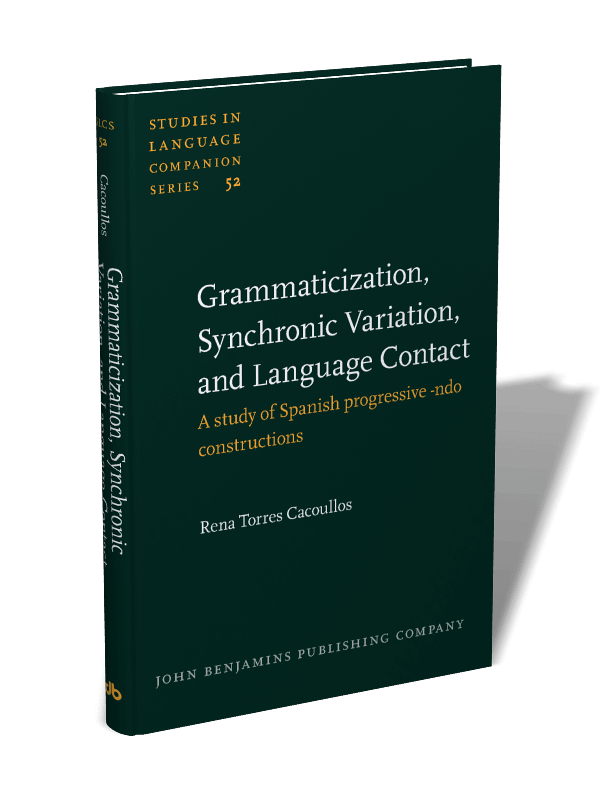
Grammaticization, Synchronic Variation, and Language Contact: A study of Spanish progressive -ndo constructions

Grammaticization, Synchronic Variation, and Language Contact: A study of Spanish progressive -ndo constructions

Author(s):

Publication Date:

About the Book

This study of Old Spanish and present-day Mexico and New Mexico data develops a grammaticization account of variation in progressive constructions. Diachronic changes in cooccurrence patterns show that grammaticization involves reductive change driven by frequency increases. Formal reduction results in the emergence of auxilliary-plus-gerund sequences as fused units. Semantically, the constructions originate as spatial expressions; their grammaticization involves gradual loss of locative features of meaning. Semantic generalization among parallel evolutionary paths results in the competition among different constructions in the domain of progressive aspect. Patterns of synchronic variation follow from both the retention of meaning differences and the routinization of frequent collocations, as well as sociolinguistic factors. Register considerations turn out to be crucial in evaluating the effects of language contact. Purported changes in Spanish — English bilingual varieties are largely a feature of oral, informal language rather than a manifestation of convergence.
Read More
Rena Torres Cacoullos Profile Image