Menu

News

Menu

News

Menu

News

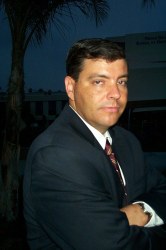
John Ochoa

John Ochoa
Professor of Spanish

Biography

John Ochoa is Professor of Spanish and Comparative Literature. His research focuses on Mexican intellectual and cultural history and on the comparative literature of the Americas, with particular interests in national identity, travel and mobility, the picaresque, and the relationships between literary form and cultural history. His work also draws extensively on psychoanalytic theory, particularly questions of subject formation, trauma, loss, and memory, across fields ranging from Chicano and border narratives to the Petrarchan lyric tradition.

His first book, The Uses of Failure in Mexican Literature and Identity (University of Texas Press, 2004), examines the recurrent representation of failure in Mexican cultural discourse and its role in the construction and critique of national identity. His work on Mexico has also addressed writers and intellectuals including Bernal Díaz del Castillo, José Vasconcelos, Agustín Yáñez, Carlos Fuentes, Alfonso Reyes, and Guillermo Gómez-Peña, as well as questions of border culture, colonial and postcolonial history, and official state culture.

His second monograph, Fellow Travelers: Dispatches of Empire in the Literature and Film of the Americas (University of Virginia Press, 2021), develops a comparative approach to travel and mobility across the Americas. Bringing together North American and Latin American texts and films, the book examines travel writing, the picaresque, and the road genre in relation to empire, revolution, national identity, and the cultural legacies of the Cold War.

Ochoa has also combined scholarship, editing, translation, and pedagogy. For the Modern Language Association, he prepared a two-volume companion edition of José Joaquín Fernández de Lizardi’s Don Catrín de la Fachenda (2021), bringing a lesser-known work by one of Mexico’s foundational nineteenth-century writers into a format designed for both scholarship and the classroom. The project pairs his annotated edition of the Spanish text with the first published English translation, by Bonnie Loder; Ochoa prepared the introductions, annotations, bibliographies, linguistic notes, and other scholarly apparatus for the two volumes. He also co-edited, with Monika Kaup, From the Americas to the World: Essays in Honor of Lois Parkinson Zamora (Lexington, 2021), to which he contributed an essay on Alejo Carpentier’s Concierto barroco, transoceanic picaresques, and revolution.

Ochoa’s research increasingly extends these comparative interests to intersections between the ancient Mediterranean and the Americas, particularly Greek literature and culture. This work brings classical materials into conversation with recurring concerns in his scholarship on Mexico and the Americas, including travel and cultural encounter, collective identity, literary form, and the uses of the past.

Selected Publications

  • Fellow Travelers: Dispatches of Empire in the Literature and Film of the Americas. University of Virginia Press, 2021.
  • With Monika Kaup, eds. From the Americas to the World: Essays in Honor of Lois Parkinson Zamora. Lexington Press, 2021.
  • José Joaquín Fernández de Lizardi, Vida y hechos del famoso caballero Don Catrín de la Fachenda. Edited with introduction, notes, and scholarly apparatus by John Ochoa. Modern Language Association, 2021.
  • José Joaquín Fernández de Lizardi, Life and Deeds of the Famous Gentleman Don Catrín de la Fachenda. Translated by Bonnie Loder; edited with introduction, notes, and scholarly apparatus by John Ochoa. Modern Language Association, 2021.
  • “The Poet Becomes Poem: The Missing Object and Petrarch’s Ends in the Canzoniere.” Romance Quarterly 65.1 (2018).
  • “Fuentes the Young.” PMLA 128.3 (2013).
  • “Professors on the Run: How Marcos’s Narratives of Zapatismo Refashion North American Cold War Anxiety.” Comparative American Studies 11.1 (2013): 52–73.
  • The Uses of Failure in Mexican Literature and Identity. University of Texas Press, 2004.

Education

Ph.D., Comparative Literature, Yale University, 1999
A.B., Independent Major in Literary Theory, Vassar College, 1990
Additional studies at the Università per Stranieri di Siena; Universidad Complutense de Madrid; and Université Paris VII

Research Interests

Mexican intellectual, literary, and cultural history; comparative literature of the Americas; Inter-American studies; psychoanalytic theory, trauma, memory, and subject formation; travel literature and the road genre; picaresque traditions; national identity and aesthetic form; colonial Latin America; Chicano and border literature and culture; Petrarch and the Petrarchan lyric tradition; classical Greek literature and culture and its intersections with the Americas.

Courses Regularly Taught

200 Level

3 Credits

Fall 2026 Semester

Spanish
SPAN 253W Introduction to Literary & Cultural Studies en Español
This course guides students toward the development of skills that will enable them to move toward a greater awareness of how literary and other cultural productions create effects and reactions in readers, viewers, and/or listeners. Moreover, it engages with these forms of expression as reflections of the diverse contexts and communities from which they emerge, situating works by a range of voices from across Latin America, Spain, and/or the U.S. within their historical, political, social, economic, and artistic contexts. Along the way, as distinctive features of each selection are highlighted, students become equipped with key tools and strategies of literary and cultural interpretation. Emphasizing critical thinking and a communicative approach to language learning, the course invites students to explore fiction, poetry, drama, film and/or other areas of cultural production (such as music, painting, photography, performance, and/or comics) through conversations and activities designed to improve their speaking, listening, reading, and writing abilities in Spanish, as well as to deepen their cultural understanding of the Spanish-speaking world.

Class Times

Mondays, Wednesdays, Fridays from 10:10 a.m.-11:10 a.m.


Class Times

Tuesdays, Thursdays from 9:05 a.m.–10:20 a.m., Tuesdays, Thursdays from 12:05 p.m.–1:20 p.m.


Prerequisite

SPAN 100; SPAN 100A; SPAN 100B; SPAN 100C; SPAN 100H


Bachelor of Arts

World Language (All), World Lang (12th Unit), Humanities, World Cultures, International Cultures (IL)


Exceeds 12th Unit of World Language


General Education

Humanities (GH)


Honors


GenEd Learning Objective

Effective Communication, Crit and Analytical Think, Integrative Thinking


Writing Across the Curriculum


400 Level

3 Credits

Fall 2026 Semester

Spanish
SPAN 479 U.S. Latina/o Culture en Español
This course is conducted in Spanish and will analyze some of the central themes that shape the diverse Latina/o experiences in the United States. Some of the main topics that the course will address include: the politics of labeling; definitions of displacements; the politics of language; imaginary homelands and geographic spaces; and conceptualizations of race, gender, and sexuality. These themes will be seen through the lens of Latina/o literature and film. The main objective of this course is to help students think critically about the conceptual, theoretical, historical, and social issues that inform the Latina/o experience in the United States.

Class Times

Tuesdays, Thursdays from 1:35 p.m.-2:50 p.m.


Prerequisite

(SPAN 100A or SPAN 200) and SPAN 253W


3 Credits

SPAN 597 Family, Nation, Telling, and Other Traumas
This course will familiarize the student with psychoanalysis as a way to approach literature and culture. We will cover its basic concepts and structures, especially with regard to trauma and post-trauma. Most relevant will be: 1) witnessing and rendering testimony; 2) inherited or misplaced trauma; 3) responses to the father figure and paternalism. For all, but especially this last topic, we will consider parallels between the individual subject and the collective psyche: both the personal and the national, or the personal as national. For specific case studies/histories, we will draw on the Latin American and Latinx canon, from the Colonial period to the present. These may include El Inca Garcilaso, Sor Juana Inés de la Cruz, Hernandez’s "Martín Fierro," caciquismo, the death of José Martí, Alfonso Reyes and his father, Rulfo’s Pedro Páramo, Cien años de soledad, the Dirty Wars of the 1970s, Rigoberta Menchú, and Gloria Anzaldúa. Theoretical readings will include psychoanalysis and trauma theory by Freud, Caruth, Felman, Laub, and on national identity by Benedict Anderson and Isiah Berlin.

3 Credits

SPAN 597 Psychoanalysis: Family, Nation, Telling, and Other Traumas
This course will familiarize the student with psychoanalysis as a way to approach literature and culture. We will cover its basic concepts and structures, including the usages of Freud, Lacan and Kristeva. Most relevant will be: 1) witnessing and rendering testimony; 2) inherited or misplaced trauma; 3) responses to the father figure and paternalism. For all, but especially this last topic, we will consider parallels between the individual subject and the collective psyche—the personal and the national—including the personal as national. Readings will include theoretical and clinical texts by Freud, Lacan, Kristeva, Caruth, Felman, Laub, and Abraham and Torok, as well as works on national identity by Doris Sommer, Benedict Anderson and Isiah Berlin. For specific case studies/histories, we will rely on a wide-ranging corpus drawn from the Latin American and Latinx canon from the colonial period to the present. Discussion will be in English, and all readings will also be available in English.

Class Times

Tuesdays, Thursdays from 9:05 a.m.-10:20 a.m.


Publications

Fellow Travelers Book Cover

Fellow Travelers: How Road Stories Shaped the Idea of the Americas

Author(s):

Publication Date:

About the Book

Road stories occupy a central place in the cultural imagination of the Americas, where journeys across seemingly boundless landscapes have helped nations define themselves and their place in the world. Fellow Travelers: How Road Stories Shaped the Idea of the Americas brings North and Latin American traditions into conversation to ask how travel, companionship, and encounters with the backcountry have shaped ideas of national identity and American exceptionalism. Moving across the late colonial and early republican era, the expansion of the frontier, and the Cold War, John Ochoa examines moments when nations throughout the hemisphere invented and reinvented themselves in the shadow of empire. Fellow Travelers pairs travelers and traveling companions across national and linguistic traditions, from the picaresque wanderers of H. H. Brackenridge and Alonso Carrió de la Vandera to the gaucho and cowboy traditions of Martín Fierroand The Searchers, and from Jack Kerouac’s On the Road and Che Guevara’s The Motorcycle Diaries to the writings of Subcomandante Marcos and Denis Johnson’s Jesus’ Son. These journeys reveal tensions between the rugged individual and the democratic many, the metropolis and the backcountry, and the intimate bonds between companions and the vast landscapes through which they move. Crossing the conventional boundary between “American” and Latin American literature, Fellow Travelers presents the road story as a shared hemispheric form through which the Americas have imagined freedom, community, empire, and their own modern identities.
Read More
Bitácora Del Cruce

Bitácora Del Cruce

Author(s):

Publication Date:

About the Book

One of the most active and creative Chicano writer-performers explores the techno-Chicano esthetic and searches for a new dialogue between Latin Americans who left their homelands following the American dream and those who stayed behind. This Log of the Border Crossing, is in itself a literary melting-pot where a new language is being forged. ‘The reader can start anywhere and read them the parts] in any order.’ Borders, after all, are there for us to go across.
Read More
The Uses of Failure in Mexican Literature and Identity

The Uses of Failure in Mexican Literature and Identity

Author(s):

Publication Date:

About the Book

While the concept of defeat in the Mexican literary canon is frequently acknowledged, it has rarely been explored in the fullness of the psychological and religious contexts that define this aspect of “mexicanidad.” Going beyond the simple narrative of self-defeat, The Uses of Failure in Mexican Literature and Identity presents a model of failure as a source of knowledge and renewed self-awareness. Studying the relationship between national identity and failure, John Ochoa revisits the foundational texts of Mexican intellectual and literary history, the “national monuments,” and offers a new vision of the pivotal events that echo throughout Mexican aesthetics and politics. The Uses of Failure in Mexican Literature and Identity encompasses five centuries of thought, including the works of the Conquistador Bernal Díaz del Castillo, whose sixteenth-century True History of the Conquest of New Spain formed Spanish-speaking Mexico’s early self-perceptions; José Vasconcelos, the essayist and politician who helped rebuild the nation after the Revolution of 1910; and the contemporary novelist Carlos Fuentes. A fascinating study of a nation’s volatile journey towards a sense of self, The Uses of Failure elegantly weaves ethical issues, the philosophical implications of language, and a sociocritical examination of Latin American writing for a sparkling addition to the dialogue on global literature.
Read More
John Ochoa Profile Image