The Italian Program
Italian is the voice of one of the major, formative cultural traditions of the Western world. The study of Italy and its language offers a rich opportunity to experience cross-cultural personal enrichment in such areas as literature, opera and music, film, art history, the modern heritage of Roman thought and civilization, fashion, politics, tourism, Mediterranean cuisine, and much more. The Italian program is small and prides itself on its capacity to provide individual attention and mentoring to each of its majors and minors.
Since 1999, the Italian Program has redesigned its pedagogical approach to the basic language series (IT 001-003), hosted popular guest lectures, offered a Freshman Seminar in Italian, increased Circolo Italiano visibility and events (Italian dinners, Carnevale celebrations, various film series, trips to the Pittsburgh Opera, bocce and soccer tournaments, etc.), established a letter-writing campaign to encourage the best students to continue their studies of Italian, offered popular new Special Topics courses and new approaches to old courses (“Introduction to Italian Culture,” instead of “Advanced Composition and Conversation II,” and “Renaissance Theories of Love: Mystical, Fraternal, and Erotic,” instead of “Italian Humanism and the Renaissance”), and brought a chapter of the National Italian Honor Society to Penn State. Without a doubt, these efforts have contributed to the more than eight-fold increase in Italian majors since 1999.
Each semester Penn State University Park offers Italian language and culture courses to nearly 550 students or more. Some of these undergraduate students eventually major or minor in Italian and, after graduation, have gone on to enjoy further education or careers in literature, teaching, international banking, law, religious vocations, editing and publishing, tourism, public relations, the military and foreign service, and medicine. These kinds of successes are the fruit of Penn State’s talented, dedicated, and hard-working Italian faculty teaching at all levels.
The Italian Major
Effective Summer 2005 there are three undergraduate Italian major options: the Bachelor of Arts in Italian Language and Literature (which most closely resembles the only Italian major that was available before Summer 2005), the Bachelor of Arts in Italian Studies, and the Bachelor of Science in Applied Italian. Each major option permits students to focus on different aspects of the study of Italian language and culture.
All of the major options offer training in the skills required for fluency in Italian and knowledge in Italian culture, civilization, and literature. Its aim is to open to the student both the traditions of one of the major formative components of the Western world and the continuing vitality of modern Italian and Italian-American life.
As one of the humanistic programs of the College of the Liberal Arts, the Italian major is not designed to be directly vocational. Nevertheless, rigorous training in any of the Italian major options can prepare students for rewarding and unique careers in business, travel, ministry, banking, and education. In addition, the federal government employs liberal arts graduates with foreign-language skills in organizations including the National Security Agency, the Central Intelligence Agency, the US Information Agency, and the Department of Labor. The Italian major is also preparatory for graduate work directed to the Ph.D. degree required for teaching and research in colleges and universities. Students with degrees in the humanities are particularly successful applicants to professional schools, such as law, business, and medicine.
In order to declare a major in Italian (any option), students should go first to the College of the Liberal Arts Undergraduate Office (138 Sparks Building, 814-865-2545) to receive the necessary paperwork. Next, students should make an appointment by email to speak with an Italian Advisor. At the advising appointment, students will discuss the various Italian major options, the courses necessary for graduation, and any other academic questions they may have. At that appointment, students will receive instructions for completing the major declaration paperwork.
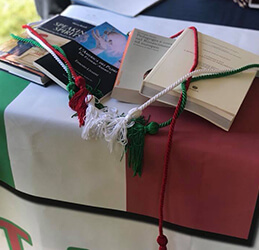
Dr. Maria Truglio stands with 2007 graduating Italian majors (from left) Carissa Monroig, Craig Diena, Maria Anderson, and Marissa Emiliani, who are wearing their laurel crowns. In 2007, the Italian Program began the new commencement tradition of wearing the symbol (as old as ancient Roman times) of distinguished scholarly or artistic achievement. Graduating seniors “earn their laurels” by completing a special Italian project of their choice during their senior year.
For more information on the Italian Major.
The Italian Minor
Students may add an Italian Minor to any Bachelor major program of study, allowing them to create a sub-specialization within their respective majors.
Please note: Changes to the Italian Minor requirements in the discussion stage. Currently, a student needs a minimum of 18 credits in Italian (6 of which must be at the 400-level), with grades of C or better, in order to receive the Italian Minor. Most of the Italian courses in the regular curriculum can be used toward the Minor (including IT 001, 002, and 003), except IT 130, 131, and 230 (See the comprehensive list on the following page.) The Faculty Senate has recommended in the future excluding elementary and possibly also intermediate language courses from the 18-credit minimum. Since it is not clear how soon the new Minor requirements will go into effect, we encourage any elementary or intermediate language student who has any interest in the Italian Minor to declare it officially as soon as possible. Students are held to the requirements that are in effect when they officially declare the Minor. They can always take more than the minimum of 18 credits if they so desire. And there is no penalty for students who change their minds and ultimately do not complete all the Minor requirements (ie, they are not disqualified from graduating if they do not complete declared Minor requirements; they simply do not receive the Minor).
In order to declare the Italian Minor, students should download a minor declaration form from the departmental website or pick up a declaration form from the department office. Students should then make an appointment with an Italian advisor, who will discuss minor requirements, sign the necessary paperwork, and instruct students on how to complete their minor declaration forms.
For more information on the Italian Minor.
Career Directions
Rigorous training in Italian can prepare students for regarding and unique careers in any of the above areas. In addition, the federal government employs liberal arts graduates with foreign-language skills in organizations including the National Security Agency, the Central Intelligence Agency, the U.S. Information Agency, and the Department of Labor. Other opportunities exist in business, travel, ministry, banking, and education; however, students who intend to teach in the public schools should contact the College of Education for specific teacher certification requirements. The Italian Major is also preporatory for graduate work directed to the Ph.D. degree required for teaching and research in colleges and universities. Students with degrees in the humanities are particularly successful applicants to professional schools, such as law and medicine.
Study Abroad
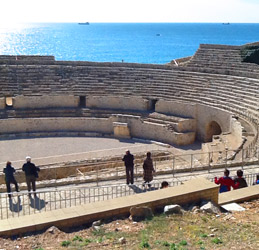
Study abroad Is an excellent way to become familiar with the Italian culture and to learn to speak Italian fluently. Penn State offers or is affiliated with study abroad programs in Todi, Rome, and Milan. For more information on these programs, contact the Department of Spanish, Italian and Portuguese at (814) 865-4252 or the Office of International Programs, 222 Boucke Building, (814) 865-7681.
Penn State's Office of International Programs (4th floor of Boucke Building), is the clearinghouse for information on any study abroad programs opportunities, including all programs in Italy. Students interested in study abroad in Italy should start at the Office of International Programs to determine which programs best correspond to their academic abilities, personal preferences, and financial situations. Some programs are offered during the academic year (for one semester or two); others are intensive programs offered during the summer. Deadlines and qualifications vary widely. Financial aid is often available.
One program in Italy is Penn State's own: the Summer Program in Todi, Italy www.outreach.psu.edu/summerabroad/. Many courses are taught by Penn State faculty members and all course offered directly correspond to PSU's current curriculum. Other programs are Penn State-affiliated, that is, they are offered through IES (in Milan or Rome), the Temple University consortium (in Rome), or the Umbria institute (in Perugia), but have already been approved for Penn State transfer credit. Still other programs are available to Penn State students, but transferable coursework must be approved on a case-by-case basis.
IMPORTANT: Once you have visited the Office of International Programs and collected information about the program(s) that interest you most, make an appointment with an Italian advisor to discuss your choice. Italian advisors can help you to determine how courses taken abroad can fit into your academic plan and provide helpful advice for planning to study abroad.
Extracurricular Opportunities in Italian
Circolo Italiano
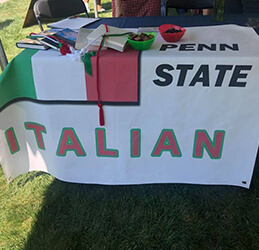
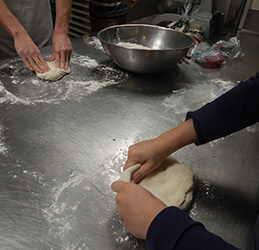
Called the Circolo Italiano, the Italian Club offers a variety of activities at the University Park campus, including bocce matches, an Italian flim series, an annual Carnevale celebration, cultural trips, and pasta and pizza parties. Italian majors, minors, or anyone else interested in learning more about the Italian culture is welcome to attend. For more information, please call Dr. Sherry Roush at (814) 865-1133 or visit the Penn State Italian Club's website.
Film Series
Each semester during the academic year a weekly or bi-weekly evening film series is offered by the department. This series runs in conjunction with the Modern Italian Literature and Cinema course (IT 475) when it is offered. Other semesters it has been organized by interested Italian faculty members. Past themes include "The South," "Eros and Power," and "Love Italian Style." More information is available from any Italian faculty members.
Guest Lectures in Italian
Occasionally the Italian program hosts guest lecturers - typically experts in the fields of Italian literature, film, or Italian-American culture - to speak to the Penn State community and public free of charge. More information is available from any Italian faculty members.
Other PSU and Local Outreach Resources Relevant to Italian Studies
Lots of opportunities to enrich your knowledge of Italian culture are readily available on campus and in the State College vicinity. Why not check out…
The Arts and Humanities Reference area of Pattee Library. It contains Italian-English dictionaries and Italian encyclopedias. Call numbers for dictionaries are PC 1460 A 17 and following, for grammar are PC 1412.M26 and following.
The Music and Media Center in the Arts and Humanities Library. It has a vast collection of Italian films on VHS, DVD, and laser disk available for check out or for viewing in the library.
The Foreign Language Tutoring Center (4 Sparks). The tutoring center offers free peer tutoring in Italian during drop-in hours that vary each semester.
Eisenhower Auditorium. The Eisenhower Auditorium sometimes hosts Italian-related productions, including traveling opera companies performing Italian operas. Call 863-0388 for more information. Student discounts are often available.
The Palmer Museum (Curtain Road). The campus art museum has a collection of Italian Baroque paintings and modern Italian prints. Free admission.
The Slide Library (209 Arts Building, behind Forum off Curtain Road). The slide library has a large collection of slides of Italian masterpieces from all periods. Call 865-3952 for more information
Courses, Syllabi and More


Penn State's Office of
One program in Italy is Penn State's own: the Summer Program in Todi, Italy