Menu

News

Menu

News

Menu

News

Matthew J. Marr

Matthew J. Marr
Associate Professor of Spanish

Curriculum Vitae

Biography

Matthew J. Marr (Ph.D., University of Virginia) is Associate Professor of Spanish. His research focuses on contemporary cultural production in Spain, with publications on film, fiction, poetry, and comics. In addition to these interests, his teaching encompasses modern Spanish literary history, thought, and society, while regularly engaging with topics in a global context. His work has been supported by grants from Spain’s Ministry of Culture (2017, 2010) and the Penn State Institute for the Arts & Humanities (2017, 2013). Prior to moving to Penn State in 2007, he held faculty positions at the University of Illinois at Chicago, Northwestern University, and Middlebury College.

His most recent book (under review) is Cine inmobiliario: Home, Place, and Property in Contemporary Spanish Film. Exploring fictional and documentary cinema produced in Spain during the first quarter of the twenty-first century, it draws on insights from fields including cultural geography, affect theory, sound studies, and film theory as it highlights a dialectic of movement and immobility that operates across both film-as-form and the spatial logic of real estate. Analyzing a selection of Spanish motion pictures varied by region and genre—from established and emerging filmmakers alike—the book builds on a substantial body of recent interdisciplinary scholarship concerned with global cinema’s reflections on the ties between immovable property, dwelling, and notions of home as place.

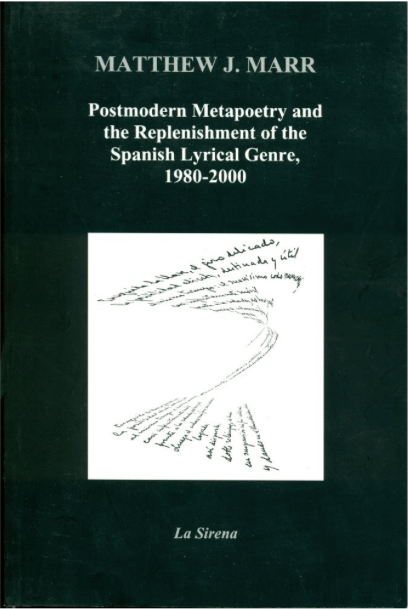
He is the co-editor (with Samuel Amago) of Consequential Art: Comics Culture in Contemporary Spain (University of Toronto Press, 2019), a volume that considers how Spanish comics practitioners have deployed image-text connections and alternative methods of seeing to interrogate memory and history, the economic and the political, the body and mental geography. In The Politics of Age and Disability in Contemporary Spanish Film: Plus Ultra Pluralism (Routledge, 2013), he takes up the cinematic construction of adolescent, senescent, and disabled subjects in an interdisciplinary analysis positioned within a broader conversation on visual culture and multiculturalism in democratic Spain. His first book, Postmodern Metapoetry and the Replenishment of the Spanish Lyrical Genre, 1980-2000 (La Sirena, 2007), examines self-referentiality in the work of leading voices within Spain’s post-Franco poesía de la experiencia movement—poets whose playful, ironic, and comic forms of self-consciousness aim to re-engage contemporary readers in a broader project of creative renewal.

Education

Ph.D., Spanish, University of Virginia
M.A., Spanish, University of Virginia
A.B., Spanish and English, College of William & Mary

Courses Regularly Taught

200 Level

3 Credits

Spring 2026 Semester

SPAN 253W Introduction to Literary & Cultural Studies en Español
This course guides students toward the development of skills that will enable them to move toward a greater awareness of how literary and other cultural productions create effects and reactions in readers, viewers, and/or listeners. Moreover, it engages with these forms of expression as reflections of the diverse contexts and communities from which they emerge, situating works by a range of voices from across Latin America, Spain, and/or the U.S. within their historical, political, social, economic, and artistic contexts. Along the way, as distinctive features of each selection are highlighted, students become equipped with key tools and strategies of literary and cultural interpretation. Emphasizing critical thinking and a communicative approach to language learning, the course invites students to explore fiction, poetry, drama, film and/or other areas of cultural production (such as music, painting, photography, performance, and/or comics) through conversations and activities designed to improve their speaking, listening, reading, and writing abilities in Spanish, as well as to deepen their cultural understanding of the Spanish-speaking world.

Class Times

Mondays, Wednesdays, Fridays from 1:25 p.m.-2:15 p.m.


Class Times

Tuesdays, Thursdays from 10:35 a.m.-11:50 a.m.


Prerequisite

SPAN 100; SPAN 100A; SPAN 100B; SPAN 100C; SPAN 100H


Bachelor of Arts

World Language (All), World Lang (12th Unit), Humanities, World Cultures, International Cultures (IL)


Exceeds 12th Unit of World Language


General Education

Humanities (GH)


Honors


GenEd Learning Objective

Effective Communication, Crit and Analytical Think, Integrative Thinking


Writing Across the Curriculum


400 Level

Spring 2026 Semester

SPAN 497-002 Short Stories and Film Shorts in Spanish
This course will feature short stories by some of Spain and Latin America's most vibrant modern narrative voices. Special attention will be given to the mechanics of suspense, cultural context, conceptions of “the real” and the fantastic, social critique, the play of language, and commentary on the human condition. We will also discuss a series of film shorts chosen as thematic companion pieces to the stories. Brief reaction papers, creative writing assignments, presentations, and active participation will be privileged over exams and research essays.

Class Times

Mondays, Wednesdays, Fridays from 2:30 p.m.-3:20 p.m.


3 Credits

SPAN 597 Contemporary Spanish Memory Studies
This course will examine various intellectual, social, and artistic formulations and uses of historical memory in contemporary Spanish culture, placing special emphasis on what has been called the memory "boom" (or, in more cynical corners, "industry") of the past quarter century. We will consider a rich set of materials—including documentary, fictional film, novels, drama, and graphic narrative—which have played no small role in catalyzing and informing Spanish society’s belated, if now vigorous, public reckoning vis-à-vis the traumas of the Civil War (1936-1939), the ensuing Franco dictatorship (1939-75), and the so-called "Pacto del Olvido" (the Pact of Forgetting) which characterized Spain’s arguably prolonged transition to democracy in the late 1970s, the 1980s, and even into the 1990s.

3 Credits

SPAN 597 Filthy Fiction(s): Spanish Naturalism, Tremendismo, and Dirty Realism
This seminar will consider late-nineteenth century Naturalism, post-Civil War Tremendismo, and Generation X "dirty realism" (or "blank fiction") of the 1990s—a triptych-like set of modern narrative sensibilities whose sordid reflections of/on the real thrust the genre of the Spanish novel beyond contemporary limits of good taste, while drawing on its foundations in the picaresque. Authors considered, by way of paired texts, will include: Emilia Pardo Bazán and Vicente Blasco Ibáñez; Camilo José Cela and Carmen Laforet; José Ángel Mañas and Lucía Etxebarría.

Current Graduate Advisees

Ramsés Martínez Barquero Profile Image
Practice Talks Coordinator for Literature, SIPSGO

Publications

Consequential Art: Comics Culture in Contemporary Spain

Consequential Art: Comics Culture in Contemporary Spain

Author(s):

Publication Date:

About the Book

Spanish comics have attracted considerable critical attention internationally: dissertations have been written, monographs have been published, and an array of cultural institutions in Spain (the media, publishing houses, bookstores, museums, and archives) have increasingly promoted the pleasures, pertinence, and power of graphic narrative to an ever-expanding readership – all in an area of cultural production that was held, until recently, to be the stuff of child’s play, the unenlightened, or the unsophisticated. This volume takes up the charge of examining how contemporary comics in Spain have confronted questions of cultural legitimacy through serious and timely engagement with diverse themes, forms, and approaches – a collective undertaking that, while keenly in step with transnational theoretical trends, foregrounds local, regional, and national dimensions particular to the late twentieth- and early twenty-first-century Spanish milieu. From memory and history to the economic and the political, and from the body and personal space to mental geography, the essays collected in Consequential Art account for several key ways in which a range of comics practitioners have deployed the image-text connection and alternative methods of seeing to interrogate some of the most significant cultural issues in Spain.
Read More
The Politics of Age and Disability in Contemporary Spanish Film: Plus Ultra Pluralism

The Politics of Age and Disability in Contemporary Spanish Film: Plus Ultra Pluralism

Author(s):

Publication Date:

About the Book

The Politics of Age and Disability in Contemporary Spanish Film examines the onscreen construction of adolescent, elderly, and disabled subjects in Spanish cinema from 1992 to the present. Applying a dual lens of film analysis and theory drawn from the allied fields of youth, age, and disability studies, this study is set both within and against a conversation on cultural diversity—with respect to gender, sexual, and ethnic identity—which has driven not only much of the past decade’s most visible and fruitful scholarship on representation in Spanish film, but also the broader parameters of discourse on post-Transition Spain in the humanities. Presenting an engaging, and heretofore under-explored, interdisciplinary approach to images of multiculturalism in what has emerged as one of recent Spain’s most vibrant areas of cultural production, this book brings a fresh, while still complementary, critical sensibility to the field of contemporary Peninsular film studies through its detailed discussion of six contemporary films (by Salvador García Ruiz, Achero Mañas, Santiago Aguilar & Luis Guridi, Marcos Carnevale, Alejandro Amenábar, and Pedro Almodóvar) and supporting reference to the production of other prominent and emerging filmmakers.
Read More
Postmodern Metapoetry and the Replenishment of the Spanish Lyrical Genre, 1980-2000

Postmodern Metapoetry and the Replenishment of the Spanish Lyrical Genre, 1980-2000

Author(s):

Publication Date:

About the Book

Literary self-consciousness is an impulse informing poets from Homer on through the splintered line of his poetic descendants. And, as poetic modes have evolved, so too have variations on the metapoetic practice. But can the problematics of the writing craft be expected to engage the contemporary reader of poetry—a figure who is awash in a world of dynamic, competing media and, thus, increasingly difficult to attract, inspire, and maintain? This question is especially relevant to modern Spanish verse, where self-reflexive poetry is cultivated toward ends that often draw attention to the lyrical genre’s condition of “exhaustion” as a literary medium. The dejected poem about the impossibility of writing, the solemn poem on the ineffable, the poem that zealously aspires to purge poetic language itself, the theory-laden meditation on the collapse of the sign: all are conventions of modern Spanish metapoetry, and all cast a shadow of crisis on the state of the genre. As if a self-fulfilling prophecy, such writerly pessimism plays its own role in poetry’s fall from grace among readers. Postmodernism seeks to reclaim this reader, and readability itself, for contemporary poetry. Within the Spanish poetic scene of the 1980s and 1990s, several practitioners of postmodernism wrest the metapoetic sensibility from the tired confines of the tradition from whence it most immediately came, reshaping it in playful, theatrical, and even comic ways—an undertaking which reinvigorates, and ultimately reorients, the Spanish lyrical genre at large. In Postmodern Metapoetry and the Replenishment of the Spanish Lyrical Genre, 1980-2000, Matthew J. Marr explores the imaginative reinvention of poetic self-consciousness by such poets as Javier Salvago, Luis García Montero, Vicente Gallego, Felipe Benítez Reyes, Carlos Marzal, and Roger Wolfe. Through a series of colorful close readings, an eye toward historical contextualization, and the fruitful application of postmodern theory, the present volume offers a refreshingly upbeat take on what is, for some of the most prominent new voices in Peninsular verse at the end of the twentieth century, a key subgenre in an innovative poetics of creative renewal.
Read More
Matthew J. Marr Profile Image